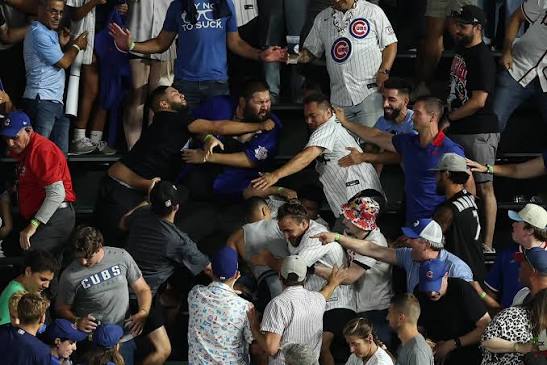
The Colosseum in the Bleachers: How the Crosstown Classic Descended into Tribal Violence
There is a fragile, midsummer pastoralism to baseball, a sport designed to be consumed under the soft hum of stadium lights with a cold beverage in hand and the gentle crack of the bat echoing through the warm night. Yet on Monday evening, beneath the revered, ivy-clad walls of Wrigley Field, that illusion of leisurely escapism shattered with violent, kinetic speed. During the highly charged Crosstown Classic—a biannual convergence of Chicago’s starkest cultural fault lines, pitting the North Side Cubs against the South Side White Sox—the iconic bleachers of the Friendly Confines metamorphosed into something resembling a gladiatorial cage. What began as a rivalry of geography quickly devolved into a primal display of public fury, leaving one spectator heavily bloodied, three in police custody, and the dark underbelly of modern fandom exposed to the flashbulbs of viral ignominy.
```
"The modern stadium has increasingly become a pressure cooker—a place where the boundary between spectator and spectacle is violently erased."
```
The melee, preserved in the clinical, high-definition framing of dozens of spectator smartphones, erupted with the sudden, jarring rhythm of a sudden squall. In the footage that quickly saturated social media, the choreography of the violence is both chaotic and intimate: bodies tumbling over green plastic seats, wild haymakers thrown with reckless abandon, and the distinct, sickening sound of physical impact rising above the ambient roar of the crowd. For several agonizing minutes, the bleachers became a theater of raw, tribal animus. Security personnel, routinely trained for the benign task of confiscating stray beach balls or escorting over-served patrons, found themselves struggling to contain a multi-person riot that left one combatant with a face painted in crimson, a visceral testament to the evening’s unchecked aggression.
The immediate aftermath of the skirmish brought the swift, sterile intervention of the Chicago Police Department, who arrested three individuals in connection with the chaos. Yet, it was the subsequent forensic revelations that elevated this bleacher brawl from a routine incident of stadium rowdiness into a darker commentary on contemporary excess. According to law enforcement sources, a search of the suspects yielded not just the predictable remnants of stadium-priced alcohol, but a quantity of suspected cocaine. The presence of class-A narcotics amidst the hot dogs and Cracker Jacks serves as a stark, somewhat surreal shorthand for the escalation of modern leisure—an indication that the simple, beer-soaked camaraderie of the ballpark is increasingly being supplanted by a high-octane, chemically-fueled desperation for intensity.
Ultimately, the incident at Wrigley Field stands as a grim vignette of our polarized moment, where the stadium serves as a pressure cooker for broader societal anxieties. When the pastoral sanctuary of the ballpark is breached by such raw, unvarnished hostility, it suggests that the games we watch are no longer functioning as an escape from our collective rage, but rather as a stage upon which we act it out. As the three defendants await their day in court, the image that lingers is not of a dramatic home run or a brilliant double play, but of a bloodied fan standing in the bleachers—a stark reminder of the thin, fraying line between civic celebration and uncivilized ruin.