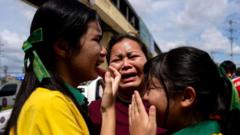
The Shattered Sanctuary: A Child’s Witness to the Classroom Massacre in Thailand
In the collective imagination, the classroom exists as a secular temple of promise—a sterile, sunlit space where the chaotic topography of the outside world is temporarily suspended in favor of blackboards, multiplication tables, and the gentle, maternal authority of educators. In rural Thailand, however, this sanctuary was not merely breached; it was violently dismantled. A young student stood mere inches from her teacher when the gunfire erupted, a chilling instant where the domestic tranquility of a school morning dissolved into the terrifying, metallic cacophony of an assassination. The suddenness of the assault, which ultimately claimed the lives of five teachers in a ruthless succession of violence, left behind a heavy silence punctuated only by the ringing in a child's ears and the sudden, catastrophic collapse of her world.
For the young survivor, the immediacy of the horror was quickly eclipsed by a primal, existential dread: the paralyzing realization that she might never see her mother again. To a child, the mother is the ultimate anchor to which all reality is tethered; to contemplate her permanent absence while standing in a room stained with the blood of her educators is to look directly into an abyss of sudden abandonment. This was not merely physical terror, but a profound psychological rupture. The student, frozen in place as her teacher fell before her, became an involuntary monument to survival—a young mind forced to negotiate the mathematics of mortality while the adults charged with her protection lay lifeless on the floor.
This tragedy underscores a grim, recurring pathology where schools are transformed from neutral zones of enlightenment into theaters of ideological or senseless violence. When educators are systematically targeted, the strike is aimed not just at individuals, but at the very infrastructure of community continuity. Teachers in these vulnerable regions do not merely instruct; they guard, nurture, and represent the fragile promise of a civilized future. In the wake of the gunfire, the physical damage to the schoolhouse may eventually be patched with plaster and fresh paint, but the psychological architecture of an entire generation of students has been fundamentally warped. The young girl’s survival is a miracle measured in inches, yet it carries the lifelong, exhausting burden of memory—a stark reminder of a day when the ultimate lesson taught was one of grief, terror, and the precariousness of peace.