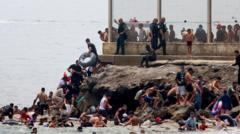
The Tide at Europe’s Gate: The Desperate Swim to Ceuta
In the shimmering, deceptive calm of the Alboran Sea, the border between two worlds is marked not by wire or stone, but by the salt-crusted drag of the tide. Ceuta, Spain’s defiant, sun-bleached enclave perched on the North African coast, has long existed as a geopolitical anomaly—a fragment of the European Union physically grafted onto the shoulder of Morocco. Recently, this liminal space became the stage for a desperate, collective choreography. Hundreds of migrants, some clad in makeshift wetsuits, others clutching plastic bottles for buoyancy, took to the water, casting their fates into the treacherous currents to swim from the Moroccan town of Fnideq to the Spanish territory. It is a spectacle of raw, physical determination that reduces the complex machinery of international diplomacy to the basic, gasping struggle for breath.
For Ceuta, a fortress-city of just under 85,000 residents, this sudden maritime influx has shattered an already fragile equilibrium. Along the rocky stretches of Tarajal beach, emergency workers and Red Cross volunteers have spent breathless nights pulling shivering souls from the surf, their bodies spent, their eyes hollowed by the cold. The enclave’s president, Juan Jesús Vivas, has issued a stark, urgent plea to Madrid, warning that local infrastructure has buckled under the weight of the humanitarian emergency. Resources are not merely strained; they are depleted. The territory's temporary reception centers, designed to act as brief transit points, are overflowing, transforming what was once an administrative bottleneck into a pressure cooker of human misery.
> "Ceuta cannot bear this pressure alone. We are at a breaking point, and the state must intervene immediately."
> — Juan Jesús Vivas, President of Ceuta
This surge exposes the delicate, often transactional nature of Spanish-Moroccan relations, where human lives frequently become leverage in a larger geopolitical chess match. For years, Madrid has relied on Rabat to act as Europe’s southern gatekeeper, a task Morocco performs with varying degrees of rigor depending on the diplomatic weather. Yet, no amount of thermal imaging, razor wire, or bilateral accords can fully extinguish the desperate calculus of those who look across the narrow stretch of water and see a different future. The swimmers of Ceuta are a poignant, harrowing reminder of a deeper modern truth: when the economic and social disparity between two shores is as vast as the sea itself, the water ceases to be an obstacle and becomes, instead, a highway of last resort.