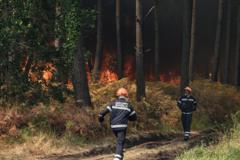
The Crucible of Gironde: Inside the Scorched Fight for the French Southwest
The Gironde region, long celebrated for its sprawling maritime pines and the sleepy, sun-drenched rhythm of its Atlantic coastline, has transformed into a furnace. As temperatures climb to a merciless 40°C, the air itself feels like a physical weight, thick with the acrid perfume of incinerated resin and drifting gray ash. Against this apocalyptic backdrop, France’s sapeurs-pompiers find themselves locked in a grueling, kinetic warfare with an elusive enemy. The earth is dry as bone, the vegetation turned to tinder, and the wind is a capricious director, capable of turning a dormant smolder into a roaring crown fire in a matter of heartbeats. It is a theater of absolute exhaustion, where the idyllic French summer is being systematically dissolved by the relentless, searing reality of a changing climate.
Yet, the crisis unfolding in the southwest is not merely ecological; it is deeply psychological, exposing a stubborn fracture in the French provincial spirit. In the direct path of the advancing flames, local authorities have issued sweeping evacuation orders, only to encounter a wall of quiet, fiercely defiant resistance. In isolated hamlets and woodland properties, some residents refuse to flee. To these holdouts, the state’s urgent directives are viewed as an overreaching intrusion, their deep-seated, generational attachment to their homes superseding the rational calculus of survival. They choose instead to stand on parched lawns with garden hoses—a frail, almost quixotic defense against a predatory inferno—illustrating a tragic refusal to accept that the landscape they have known for decades has suddenly become hostile to human life.
> "To leave is to surrender the only thing we have left to protect. The fire may take the trees, but it will have to fight us for the stone."
For the exhausted emergency crews, this human obstinacy adds a layer of bitter complexity to an already perilous campaign. Clad in heavy, sweat-soaked turnout gear under a white-hot sky, firefighters are forced to split their focus, battling volatile flare-ups while simultaneously coaxing stubborn citizens out of harm's way. It is a war of attrition played out in agonizing micro-tactics: cutting hasty firebreaks through beloved vineyards, monitoring shifting wind corridors, and snatching moments of fitful sleep on scorched earth. What is happening in the Gironde is more than a seasonal emergency; it is a stark, elegant warning—a preview of a continent caught between the inertia of its cherished, historic lifestyle and the volatile, fiery future that has already arrived at its doorstep.