The Crucible of the Continent: Europe’s New, Hostile Summer
As NASA’s satellites capture record-shattering thermal anomalies, the Old World faces a searing existential reckoning with the Anthropocene.
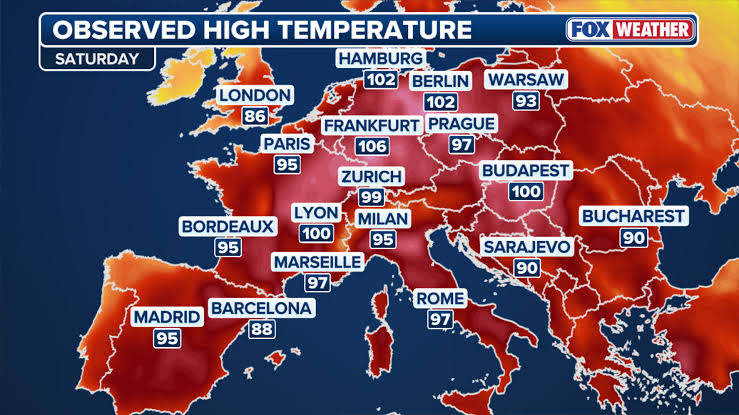
In the collective imagination, the European summer has long existed as an aesthetic ideal—a sun-drenched tableau of terracotta rooftops, languid afternoons by the Seine, and the cooling spray of Roman fountains. But by the peak of 2026, that romanticized postcard has melted into something far more predatory. The continent is no longer merely warm; it is baking under a merciless, static atmospheric dome that has transformed historic capitals into crucibles of dust and stone. From the Iberian Peninsula to the normally temperate reaches of Scandinavia, the heat is not a passing discomfort but an existential assault, redefining the rhythms of daily life and forcing a population accustomed to seasonal predictability to adapt to a hostile new climate regime.
The scale of this meteorological siege is laid bare in the stark, infrared telemetry of NASA’s Earth Observatory. Satellite imaging reveals a continent draped in a bruised palette of deep purples and scorching magentas—a visual testament to soil moisture levels plunged to historic lows and surface temperatures that routinely shatter twentieth-century benchmarks. Climatologists analyzing the data warn that these persistent heat domes are no longer anomalous aberrations but the permanent architecture of a rearranged global atmosphere. As the jet stream falters, superheated air dredged directly from the Sahara remains trapped over Europe's urban centers, turning celebrated limestone and marble architecture into giant storage heaters that radiate suffocating warmth long into the sleepless, heavy nights.
> "The stone cities of Europe were built to retain warmth, a brilliant design for the Little Ice Age, but a dangerous trap in the era of global boiling."
The consequences are both subtly insidious and violently disruptive. Rivers that once carried the commerce of empires are shrinking to trickles, exposing dry beds and halting vital shipping arteries, while Alpine glaciers weep under the glare of unprecedented high-altitude temperatures. In the cities, the lack of widespread residential air conditioning—once defended as a mark of ecological sensibility and architectural preservation—has transformed from a charming cultural eccentricity into a lethal vulnerability. Emergency services are strained to their limits, treating a silent, mounting influx of heat-related illnesses, while the elderly and marginalized find themselves trapped in upper-floor apartments that feel less like homes and more like brick kilns.
Ultimately, this scorching summer marks the death of a certain European exceptionalism. The continent can no longer view climate disruption as a future tense tragedy occurring elsewhere, a distant crisis to be debated in the air-conditioned corridors of Brussels. It is here, peeling the paint off the shutters of Provencal villas and cracking the clay soils of Tuscan vineyards. As residents and tourists alike seek refuge in the subterranean shadows of ancient cathedrals, there is a quiet, collective realization that the climate of the past is gone. In its place is a new, searing reality where survival requires a complete rewriting of how Europe builds, works, and imagines its future under an unforgiving sun.