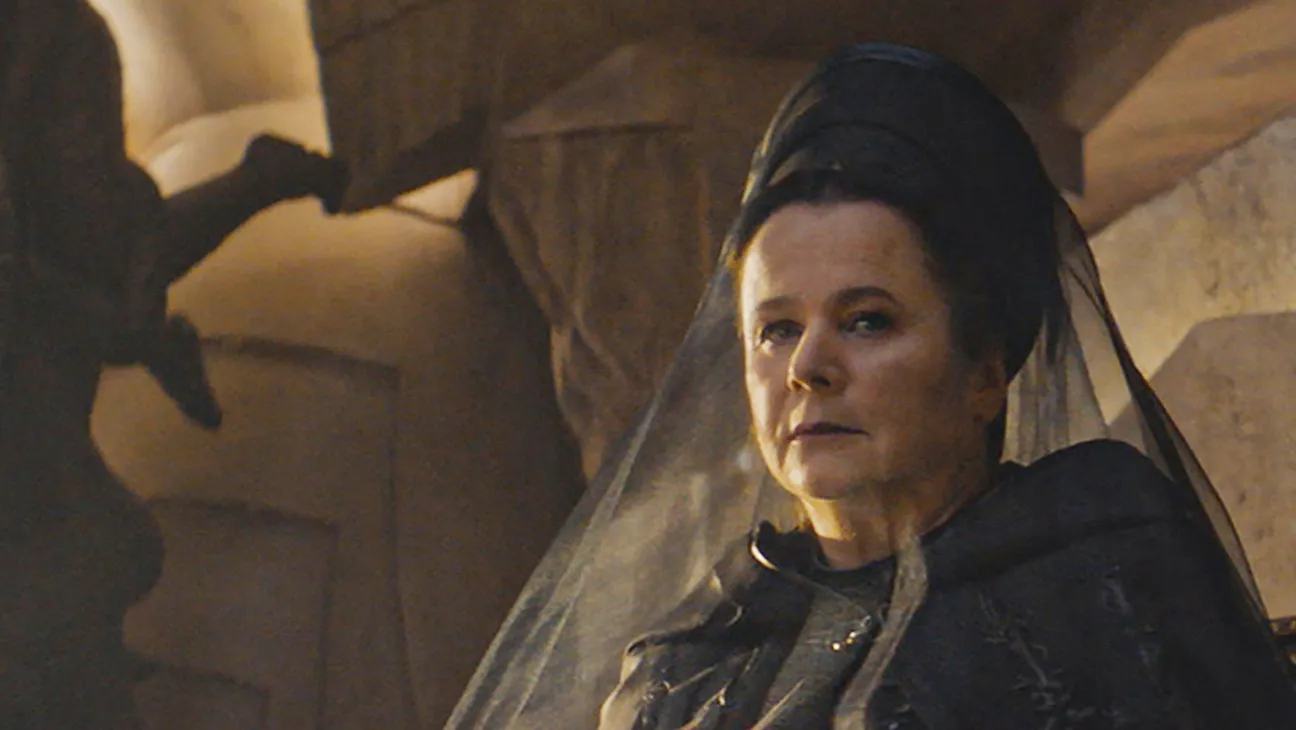
The Sovereign Quest of Emily Watson
For decades, the cinematic silhouette of Emily Watson was defined by a rare, almost bruising emotional vulnerability. To recall her breakthrough is to conjure the wind-whipped shores of Lars von Trier’s Breaking the Waves, where her eyes mirrored a devotion both terrifying and holy, or the quiet, class-bound domesticity of Robert Altman’s Gosford Park. She was the patron saint of the exposed nerve, an actress who colonized the high-art margins of cinema with performances of raw, unfiltered intimacy. Now, draped in the austere, obsidian vestments of Valya Harkonnen in the sprawling sci-fi epic Dune: Prophecy, Watson has traded the quiet chambers of the arthouse for the imperial machinery of peak television. It is a pivot that, on paper, looks like a surrender to the modern franchise monoculture, but in practice, has revealed itself to be a masterful seizure of sovereignty.
To hear Watson describe this transition is to understand that her journey into the deep space of the Imperium is not merely a stylistic departure, but a reclamation of narrative territory. Reflecting on her transition into the second season of the series, Watson noted that the role has led her on "a quest in a way actors always get to do and actresses don’t." It is an incisive cultural observation. For generations, the sweeping, mythic odysseys of political philosophy, existential ruin, and world-building have been overwhelmingly gendered as masculine prerogatives, leaving female characters to occupy the static spaces of the domestic, the romantic, or the sacrificed. In the brutalist, shadow-drenched corridors of the early Sisterhood, however, Watson is the primary architect of a galaxy's fate, wielding the kind of ruthless, active agency historically reserved for tragic kings.
```
"It is a quest in a way actors always get to do and actresses don’t."
— Emily Watson
```
As the production prepares to embark on its second season, Watson appears increasingly settled within the vast, computerized ecology of the blockbuster set. Having navigated the dizzying world-building and green-screen anxieties of the debut season, she promises that the upcoming episodes will introduce "lots of new elements," teasing a narrative that will push the boundaries of her character’s psychological and political warfare. For a performer who built her reputation on the subtle, kinetic movements of the human heart, the triumph of Dune: Prophecy is her ability to infuse a massive, CGI-laden tapestry with genuine, blood-red vitality. In her hands, the Bene Gesserit rise is not just a sci-fi prologue, but an intimate, high-stakes chronicle of power, proving that the most treacherous terrain in any galaxy remains the human soul.