Shadows on the Tarmac: A Silent Threat in the European Skies
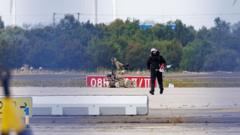
The quiet efficiency of German logistics has long been the pride of the continent’s industrial heartland, but last week, that sterile composure was shattered by the silent intrusion of modern asymmetric warfare. On the tarmac of a major German airfield—a critical junction for international freight—authorities discovered a drone laden with explosives, crouched like an unwanted sentinel near a cluster of Ukrainian cargo aircraft. These towering giants of aviation, the legendary workhorses of humanitarian and logistical lifelines for a besieged nation, have suddenly become lightning rods for a more insidious brand of sabotage. The discovery, confirmed by German police, immediately transformed a routine transit hub into a highly sensitive crime scene, exposing the delicate, fraying edges of European security where the cold reality of geopolitical conflict bleeds imperceptibly into the West.
```
"The collision represents a daring escalation in what defense analysts increasingly categorize as 'gray-zone' warfare—acts of sabotage designed to disrupt and terrorize, all while maintaining plausible deniability."
```
The tension escalated from a latent threat to active kinetic disruption shortly thereafter. In a sequence of events that reads like a contemporary technocratic thriller, another unidentified object collided mid-air with a cargo aircraft. While the physical damage and the precise origin of the second vessel remain shrouded in the fog of ongoing federal investigations, the implication of the encounter was alarmingly clear. This was not the idle curiosity of hobbyists, but a calculated penetration of airspace. The collision represents a daring escalation in what defense analysts increasingly categorize as "gray-zone" warfare—acts of sabotage designed to disrupt and terrorize, all while maintaining just enough plausible deniability to evade direct military retaliation. On the ground, the routine hum of the airfield was replaced by the frantic activity of forensic teams and intelligence officers, tracing the digital and physical fingerprints of a weapon designed to strike without a pilot.
This dual infraction suggests a coordinated campaign rather than an isolated act of vandalism, underscoring a grim new reality: the skies over Europe are no longer neutral sanctuaries. For months, Western intelligence agencies have warned that hostile hybrid operations are expanding outward from the Eastern front, targeting the critical infrastructure, logistics, and supply lines vital to Ukraine’s survival. By targeting cargo hubs and the heavy lifters of the sky, whoever orchestrated this plot aimed directly at the arteries of Western support. As investigators dissect the recovered drone’s circuitry and analyze the debris of the mid-air collision, the broader political mood in Germany shifts toward an uneasy vigilance. The war, once compartmentalized behind geopolitical boundaries, has quietly touched down on the tarmac, proving that in the age of autonomous weaponry, the distance between peace and conflict is merely a matter of altitude.