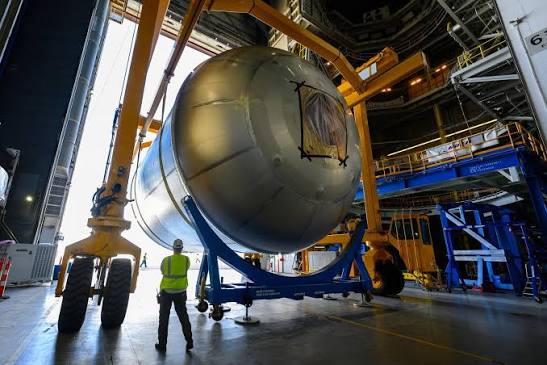
NASA Milestones: Crews Move 130-Foot Artemis IV Liquid Hydrogen Tank for Critical Testing
NEW ORLEANS — In a major step forward for the future of deep space exploration, engineering teams at NASA’s historic Michoud Assembly Facility in New Orleans successfully executed a precision transport operation on May 15, 2026, moving the massive 130-foot-tall liquid hydrogen tank for the Artemis IV mission. The colossal propellant tank was carefully rolled out of its primary production cell inside the main factory building and transported across the 829-acre campus to a detached testing facility. This milestone marks a critical transition from structural fabrication to rigorous environmental validation for the heavy-lift hardware.
The liquid hydrogen tank is the single largest structural component of the Space Launch System (SLS) core stage. When fully operational, it will hold 537,000 gallons of supercooled liquid propellant, which, alongside liquid oxygen, will feed the four RS-25 engines at the base of the rocket to generate millions of pounds of thrust. The Artemis IV mission will represent a major programmatic shift for NASA, serving as the debut flight of the upgraded SLS Block 1B configuration. This advanced variant replaces the interim upper stage with a more powerful Exploration Upper Stage (EUS), allowing NASA to send both astronauts and heavy habitation modules to lunar orbit in a single launch.
At the dedicated testing facility, technicians will subject the massive tank to a series of pneumatic and structural tests designed to simulate the extreme aerodynamic forces and internal pressures experienced during launch. "Successfully moving this hardware out of the assembly cell is a testament to the steady, industrialized rhythm we are establishing for the SLS production pipeline," said a senior NASA manufacturing manager. "As we assemble the hardware that will sustain a permanent human presence in deep space, safety and structural integrity remain our highest priorities."
The progression of Artemis IV hardware highlights the maturity of NASA’s long-term lunar infrastructure goals. While earlier Artemis missions focus on establishing initial landing capabilities and testing crew systems, Artemis IV is slated to deliver the international habitat module (I-Hab) to the Lunar Gateway—a crewed outpost that will orbit the Moon. By running concurrent manufacturing lines for multiple Artemis core stages at Michoud, NASA and prime contractor Boeing are working to ensure a reliable flight cadence for the next decade of deep space exploration.