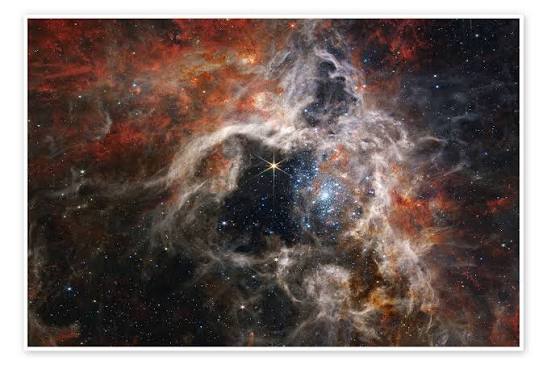
The Cosmic Baroque: How Three Great Observatories Rewrote the Aesthetics of the Void
On August 11, 2026, humanity was gifted another mirror to its own insignificance, rendered in shades of violent magenta, electric blue, and smoldering amber. The subject is 30 Doradus, colloquially known as the Tarantula Nebula—a chaotic, star-forming crucible perched some 160,000 light-years away in the Large Magellanic Cloud. What NASA has released is not a simple photograph, but an opulent, multi-layered tapestry; a celestial collage that translates the unspeakable violence of stellar birth into an aesthetic masterpiece of the cosmic baroque. To look upon this region of space is to witness a nursery that behaves like a battlefield, where infant stellar giants carve out cavities in the cold interstellar medium, draping themselves in gossamer webs of superheated gas.
```
"We do not merely observe the universe; we curate it, turning the terrifying infinity of the void into something structured, beautiful, and intimately ours."
```
A Triangulation of Sight
This arresting portrait is the result of a high-concept triangulation of human ingenuity, blending data from three of history’s most formidable space observatories. Each telescope acts as a distinct instrument in a symphonic arrangement:
- The James Webb Space Telescope provides the structural skeleton, capturing the cool, dusty filaments in the infrared that mimic the delicate anatomy of a spider's web.
- The Hubble Space Telescope contributes its classical optical-light elegance, highlighting the brilliant, hot stars that populate the nebula's core.
- The Chandra X-ray Observatory punctures the scene with high-energy outbursts—shocks of piercing light representing gas heated to millions of degrees by supernova remnants and stellar winds.
It is an exercise in archival translation: taking wavelengths of light entirely alien to the human eye and rendering them into a visual vocabulary that we can not only comprehend, but deeply feel.
The Art of Celestial Creation
There is a profound cultural irony in our contemporary obsession with these deep-space vistas. At a moment when our own world feels increasingly fractured and fragile, we look to the distant heavens to find solace in a different, grander kind of chaos. The Tarantula Nebula is a reminder that creation is inherently destructive; it is an environment of extreme thermodynamic turbulence where new worlds are forged from the violent wreckage of their predecessors. By synthesizing the distinct visions of Chandra, Webb, and Hubble, astronomers have managed to freeze a moment of pure cosmic ecstasy. In doing so, we are reminded that our drive to map the stars is not merely scientific—it is a deeply poetic attempt to find order within the beautiful, terrifying sublime.