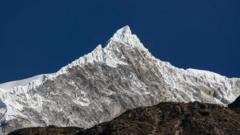
The Fraying Summit: How a Collapsed Himalayan Glacier Signaled a New Era of Alpine Peril
For centuries, the colossal spine of the Himalaya stood as the world’s ultimate monument to permanence—an immense, frozen fortress of rock and ice that seemed indifferent to the fleeting epochs of humanity. But today, the roof of the world is roaring. The devastating torrent of mud, water, and shattered ice that recently tore through the high-altitude borderlands of Nepal and Tibet has been traced by scientists to a catastrophic glacial collapse. This was not the slow, weeping retreat of ice familiar to climate models, but a sudden, structural failure: a mountainside giving way as its icy mortar turned to liquid, sending a devastating surge downstream and rewriting the geography of a fragile frontier.
What occurred in this remote trans-Himalayan corridor is the visceral manifestation of a warming planet, a phenomenon scientists refer to with increasing urgency as they study the Earth’s "Third Pole." As global temperatures rise, the internal plumbing of these ancient glaciers is undergoing a volatile metamorphosis. Meltwater, trapped under immense pressure beneath hundreds of feet of ice, acts as a subterranean lubricant. The result is a terrifying thermodynamic instability, where glaciers no longer merely melt; they shatter, slip, and burst. This latest disaster, likely a Glacial Lake Outburst Flood (GLOF) or a massive ice-rock avalanche, reveals a landscape whose very foundations are rotting from the inside out, turning life-giving water sources into unpredictable engines of destruction.
> "The mountains are losing their bones. What we are witnessing is the literal deconstruction of the high altitude, where the ice that once bound these peaks together is turning against the valleys below."
Beyond the sheer geomorphology of the disaster lies a deeper, more unsettling human truth. The communities nestled in the deep, terraced shadows of these peaks are living on the front lines of an ecological debt they did not incur. For generations, Himalayan pastoralists and farmers have read the mountains like a sacred text, noting the retreat of the snowlines and the eerie, unseasonal warmth of the alpine winds. Yet no amount of ancestral wisdom can prepare a community for the moment a mountain chooses to liquefy. The tragedy along the Nepal-Tibet border exposes the acute vulnerability of human settlement in the Anthropocene, where borders drawn on maps are easily erased by the indifferent physics of a collapsing cryosphere.
As researchers scramble to analyze satellite imagery and map the scar left by the failed glacier, the broader implications loom large over the continent. The glaciers of the Himalaya feed the great river systems of Asia, sustaining nearly two billion people downstream. To lose these glaciers is to jeopardize the agricultural, geopolitical, and economic stability of an entire hemisphere. This latest flood is not an isolated anomaly, but a thunderous warning shot from a landscape in terminal crisis. The frozen sentinels of the Himalaya are running out of time—and the valleys below are running out of sanctuary.