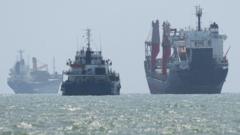
The Friction of Empire: Beijing Defies Washington’s Financial Cordons
In the theater of modern geopolitics, oil behaves as both the lubricant of global industry and the primary friction point of empire. The latest skirmish in this enduring cold war of commerce erupted with sharp rhetorical fire, as Beijing fiercely condemned Washington’s newly minted sanctions targeting Iran and its international trading network. Describing the American embargo as fundamentally "illegal" and overreaching, the Chinese Ministry of Foreign Affairs laid bare the widening chasm between the Western architecture of financial coercion and the multipolar reality of Eurasian trade. At its core, this is not merely a dispute over tankers and crude, but a fundamental clash over who commands the global commons and who possesses the authority to police them.
Washington’s strategy operates on a logic of absolute financial isolation, presenting the international community with an uncompromising ultimatum: align with the Treasury Department’s blacklist or find yourselves permanently banished from the dollar-denominated global economy. Yet, this "maximum pressure" doctrine routinely collides with the stubborn pragmatism of Beijing. For China, the world's largest crude importer, Iranian oil is not just a cheap, reliable commodity, but a strategic asset secured through "dark fleets" and custom clearinghouses operating well outside the reach of Western oversight. In attempting to sever these arteries, the United States is testing the absolute limits of its financial hegemony, betting that the threat of exclusion can still compel obedience in an era where alternative economic gravity wells are rapidly forming.
> "Unilateral sanctions lack the moral and legal authority of the United Nations Security Council—serving only to destabilize global supply chains."
By branding these sanctions as "illegal," Beijing does more than defend its energy pipeline; it seeks to delegitimize the very mechanism of American extraterritorial law. This rhetorical resistance is matched by a quiet, systemic decoupling. As the U.S. tightens its economic chokehold, it inadvertently accelerates the creation of parallel financial ecosystems, driving Beijing and Tehran into a tighter, sanctions-proof embrace. What Washington envisions as a sanitizing isolation may instead serve to catalyze a resilient shadow coalition, proving that in the modern fragmented world, absolute economic blockade is increasingly an illusion.