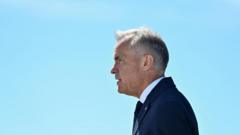
The Technocrat’s Gambit: Carney’s High-Stakes Defiance in the Shadow of Washington
In the theater of modern statecraft, there are moments when silence carries a far more deafening resonance than any diplomatic communique. For Canadian Prime Minister Mark Carney, that moment arrived with the quiet click of a briefcase latch and a calculated walk away from the negotiating table in Washington. It was a maneuver of staggering audacity—a high-stakes gambit of defiance against a transactional Trump administration that views compromise as a form of weakness. By choosing to reject a compromised covenant rather than sign a submissive peace, Carney has traded the predictability of bilateral alignment for the volatile, uncharted waters of economic sovereignty. Now, back under the gray, neoclassical vaults of Ottawa, he faces an adversary far more formidable than the unpredictable tenant of the White House: a deeply anxious domestic electorate and a business establishment wondering if their leader’s calculation was an act of principled courage or a catastrophic error in hubris.
The clash was perhaps inevitable, born of two irreconcilable political species. On one side stands Donald Trump, the ultimate avatar of zero-sum mercantilism, who wields access to the American market like a cudgel. On the other is Carney, the quintessential high priest of global technocracy—cool, polished, and historically accustomed to the orderly friction of central banking rather than the raw, blood-sport choreography of populist diplomacy. In walking away, Carney sought to expose the limits of Washington’s leverage, betting that Canada's critical resources and deeply integrated supply chains would make a punitive trade war too costly for the Americans to sustain. Yet, this intellectual elegance must now survive the blunt-force trauma of real-world consequences, where tariffs are not abstract economic equations but existential threats to factories in Ontario and resource sectors in the West.
The Domestic Arena
To survive the impending political fallout, Carney must now embark on a masterclass of political salesmanship, transforming a tactical retreat into a narrative of national dignity. It is a delicate, precarious performance. He must convince a jittery business class—long accustomed to the comforting, if sometimes suffocating, embrace of the continental trade umbrella—that short-term economic pain is a necessary price for long-term strategic autonomy. Already, his domestic opponents are sharpening their knives, painting the Prime Minister as a detached cosmopolitan elite whose personal pride has jeopardized the livelihoods of everyday Canadians. The coming weeks will test whether Carney’s refined, analytical cadence can resonate with a public far more concerned with the immediate threat of escalating consumer prices than the abstract virtues of sovereign defiance.
Ultimately, Carney’s gamble represents a defining crossroads for middle-power diplomacy in an era of resurgent nationalism. For decades, Canada’s foreign policy has rested on the comfortable assumption that rationality and rules-based international systems would always prevail over raw power dynamics. By walking away from the table, Carney has exposed the fragility of that assumption, choosing instead to meet raw power with a cool, calculated refusal. Whether history records this as the moment Canada found its spine or the moment its prime minister misjudged his hand remains to be seen. But as the chill wind sweeps across Parliament Hill, one thing is certain: the technocrat has stepped fully into the political arena, and the price of admission may cost him everything.