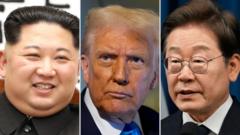
The Performance of Peace: Trump’s Transactional Detente on the Korean Peninsula
In the mercurial theater of modern American statecraft, foreign policy has increasingly ceased to resemble a calculated chess match of slow, institutional moves, transforming instead into a series of highly personalized, prime-time transactions. The latest and perhaps most jarring manifestation of this shift is Donald Trump’s sudden declaration that the United States will "substantially reduce" its joint military exercises with South Korea. It is a decision that dismantles decades of orthodox security strategy in a single stroke, justified not through the sterile dialectic of diplomatic leverage, but through the warmer, more volatile currency of a "very good relationship" with North Korean leader Kim Jong Un.
For generations, these biannual joint war games were the steel-plated guarantee of Washington's commitment to Seoul—a synchronized display of allied military muscle designed to deter aggression from a nuclear-armed Pyongyang. To the defense establishment in Washington and the anxious leadership in Seoul, these exercises represent the vital, operational connective tissue of their alliance. To suspend or diminish them is to yield a formidable bargaining chip for an intangible return. Pyongyang has long denounced these maneuvers as provocative rehearsals for invasion; by echoing this sentiment and dismissing the drills as both exorbitantly expensive and "provocative," Trump has effectively adopted the rhetorical framing of his adversary, sending shockwaves through the pentagonal corridors of traditional foreign policy.
> "In dismantling the hard-won machinery of deterrence for the sake of personal rapport, the administration risks trading the enduring stability of an alliance for the fleeting warmth of a handshake."
This pivot underscores a broader, more disruptive philosophy of governance—one that consistently privileges the visceral over the systemic. In this administration’s worldview, the complex, multilateral realities of global security are distilled into the simple chemistry of the boardroom. The historic summits and personal correspondence between Trump and Kim are treated as far more reliable guarantors of peace than the dry treaties and joint commands of the Pentagon. It is a gamble of breathtaking audacity, betting that a dictator's personal goodwill can outlast the institutional architecture designed to contain him.
As Seoul watches the horizon with a mixture of quiet alarm and forced diplomatic optimism, the Korean Peninsula remains suspended in a state of delicate, improvised truce. The reduction of these exercises represents a high-stakes experiment in unilateral concession. If the gamble fails, the United States may find that in dismantling the hard-won machinery of deterrence for the sake of personal rapport, it has traded the enduring stability of an alliance for the fleeting warmth of a handshake, leaving the Pacific theater infinitely more fragile than before.