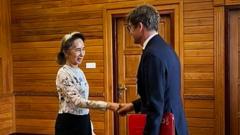
The Shadow on the Wall: Aung San Suu Kyi and the Theatre of Captivity
For thirty months, she existed in a political slipstream, a quiet phantom of Myanmar’s aborted democratic spring. Then, with the abruptness characteristic of military regimes seeking diplomatic leverage, the state-controlled apparatus offered a sudden burst of curated light. Newly released photographs, issued by the ruling military junta, depict Aung San Suu Kyi meeting with an official from the International Committee of the Red Cross (ICRC)—her first confirmed contact with the outside world in two and a half years. In the images, the 79-year-old deposed leader appears frail but composed, her posture retaining the familiar, austere discipline that has defined her public persona for decades. Yet the immaculate composition of the scene cannot obscure its underlying function: this is proof-of-life as political theatre, staged by a regime increasingly starved of international legitimacy.
The timing of this choreographed revelation is far from accidental. The Tatmadaw, Myanmar’s ruling junta, currently finds itself in its most precarious position since the February 2021 coup, battered by a coordinated and surprisingly resilient armed resistance across the country’s rugged periphery. By allowing a neutral international emissary into Suu Kyi’s orbit, the generals are signaling a calculated concession to regional neighbors and Western critics. It is a grimly familiar script for the Nobel laureate, whose life has been characterized by a tragic cycle of confinement and release. Once again, she is reduced to a human barometer of her country’s crisis, her physical body used as a diplomatic currency by the very men who stripped her of power.
Beneath the superficial reassurance of the photographs lies a profound and bitter irony. The woman who was once celebrated as the global high priestess of human rights—only to later tarnish her international reputation by defending the military’s atrocities against the Rohingya at The Hague—is now trapped in the jaws of the machine she tried to appease. Serving a combined sentence of more than twenty years on a labyrinth of politically motivated charges, her isolation has been near-total. While the ICRC’s access suggests her health has endured the rigors of solitary confinement, it also highlights the limits of international diplomacy in a state governed by the gun. The message of the photographs is ultimately double-edged: Aung San Suu Kyi lives, but she remains entirely at the mercy of her jailers.