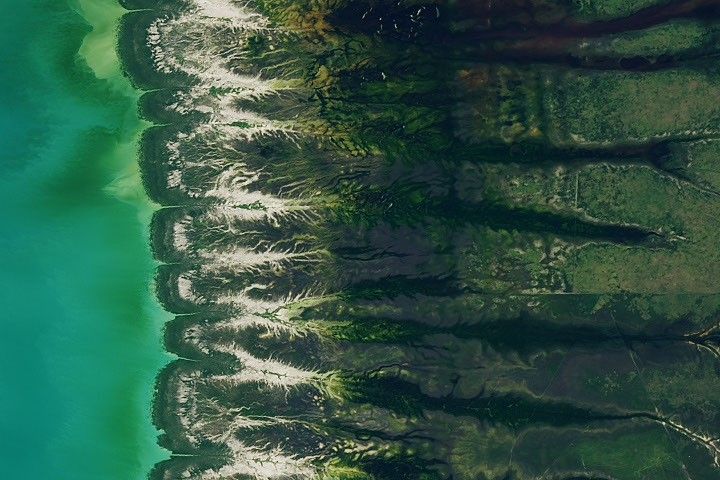
The Earth as an Enigma: Inside the High-Altitude Parlor Game of the Satellite Puzzler
To look at the Earth from a few hundred miles above is to witness a profound, disorienting abstraction. Swirls of oceanic sediment appear as brushstrokes of turquoise silk; jagged mountain ranges mimic the cracked leather of an ancient boot; river deltas branch outward like the fragile capillaries of a leviathan. For years, NASA’s Earth Observatory has tapped into this surreal cartography through its monthly "Satellite Puzzler," an intellectual parlor game that challenges the ground-bound to identify a nameless, context-free patch of the planet from orbit. The August 2026 iteration arrives not merely as a test of geographical trivia, but as a quiet, compelling meditation on our relationship with a changing world. It asks us to look at the unfamiliar and find the thread of human history, geology, or ecological transformation that makes it singular.
The challenge has spawned its own breed of digital detective—armchair cartographers, climate scientists, and open-source intelligence enthusiasts who parse these nameless images with obsessive precision. Armed with multispectral analysis tools, historical weather data, and an intimate knowledge of global geomorphology, these sleuths seek out the anomalies. What looks to the untrained eye like a harmless fractal of white lines across a brown canvas might actually be a retreating glacier, or perhaps the stark borders of a geopolitical dispute traced in agricultural irrigation. The thrill lies in decoding these visual riddles, transforming a sterile, high-resolution JPEG into a narrative of deep time or immediate crisis. In this digital panopticon, every pixel is pregnant with meaning, and every landscape has a confession to make.
> "The puzzle is never just about finding a latitude and longitude; it is about uncovering why the spot matters."
This monthly exercise underscores a deeper cultural tension of the satellite age: the seductive beauty of environmental distress. Often, the most visually arresting satellite images—the ones boasting the most vibrant, unnatural hues of neon green or deep rust—are those that depict toxic algal blooms, open-pit mining, or the devastating scars of wildfire. The Puzzler forces a confrontation with this aesthetic paradox. To solve the riddle is to realize that the sublime patterns we admire from the safety of our screens are frequently the physical manifestations of Anthropocene friction. The curiosity that drives the game is thus double-edged, balancing an awe of natural beauty with the sobering realities of planetary change.
Ultimately, NASA’s challenge does more than democratize scientific observation; it reframes the skyward gaze. In an era where the Earth can feel thoroughly mapped, conquered, and commodified, the Puzzler restores a sense of radical mystery to the globe. It reminds us that even under the constant, unblinking surveillance of our orbital machinery, the planet remains a manuscript waiting to be translated. As the August guesses roll in, the exercise becomes a collective act of paying attention—a necessary pause to look closely at the only home we have, and to understand, piece by piece, the stories written upon its skin.