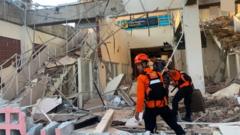
Shadows on the Ring of Fire: A Deadly Convergence off Flores Island
The dawn that broke over the volcanic spine of Flores Island on Saturday morning was shattered not by the gentle rise of the tropical sun, but by the violent, convulsing heave of the earth itself. Measuring a massive 7.7 on the Richter scale, the undersea earthquake struck with a sudden, predatory force, sending shockwaves through the deep waters of eastern Indonesia and instantly transforming a quiet weekend morning into a theatre of panic and ruin. In this sprawling archipelago, where the breathtaking beauty of the landscape is forever married to its geologic volatility, this latest tremor served as a brutal reminder of the precarious terms upon which human settlement exists in the shadow of the Ring of Fire.
Early casualty reports paint a sobering picture of the devastation, with local authorities confirming at least 14 dead—a toll that officials fear may rise as rescue teams navigate fractured roads and severed communications to reach remote coastal hamlets. Concrete homes collapsed into heaps of dusty rubble, trapping families asleep in their beds, while terrified residents fled into the darkness of the early hours, haunted by the dual terrors of collapsing infrastructure and the looming specter of a tsunami. In towns across East Nusa Tenggara, the immediate aftermath was defined by a frantic, collective desperation: neighbors digging through debris with bare hands, their efforts illuminated only by the sweep of flashlights and the rising, indifferent light of day.
> "In the Indonesian archipelago, the earth is not a static foundation, but a restless, living entity whose occasional shrugs can rewrite the destiny of entire communities in a matter of seconds."
Beyond the immediate humanitarian crisis lies a deeper, cyclical tragedy that characterizes life on the geological fault lines of Southeast Asia. Indonesia's geography is one of sublime beauty punctuated by sudden, catastrophic violence; its islands are lush and fertile precisely because of the tectonic collisions that threaten to destroy them. As seismologists analyze the fault mechanics of the Flores Sea strike, the citizens of Flores are left with the daunting, familiar task of reclamation. It is an exercise in resilience that is as quiet as it is heroic—a stubborn determination to rebuild atop the very fault lines that have once again betrayed them, proving that while the earth may fracture, the human resolve to endure remains remarkably unbroken.