High Wire in the Abyss: The Quiet Geometry of an Orbital Upgrade
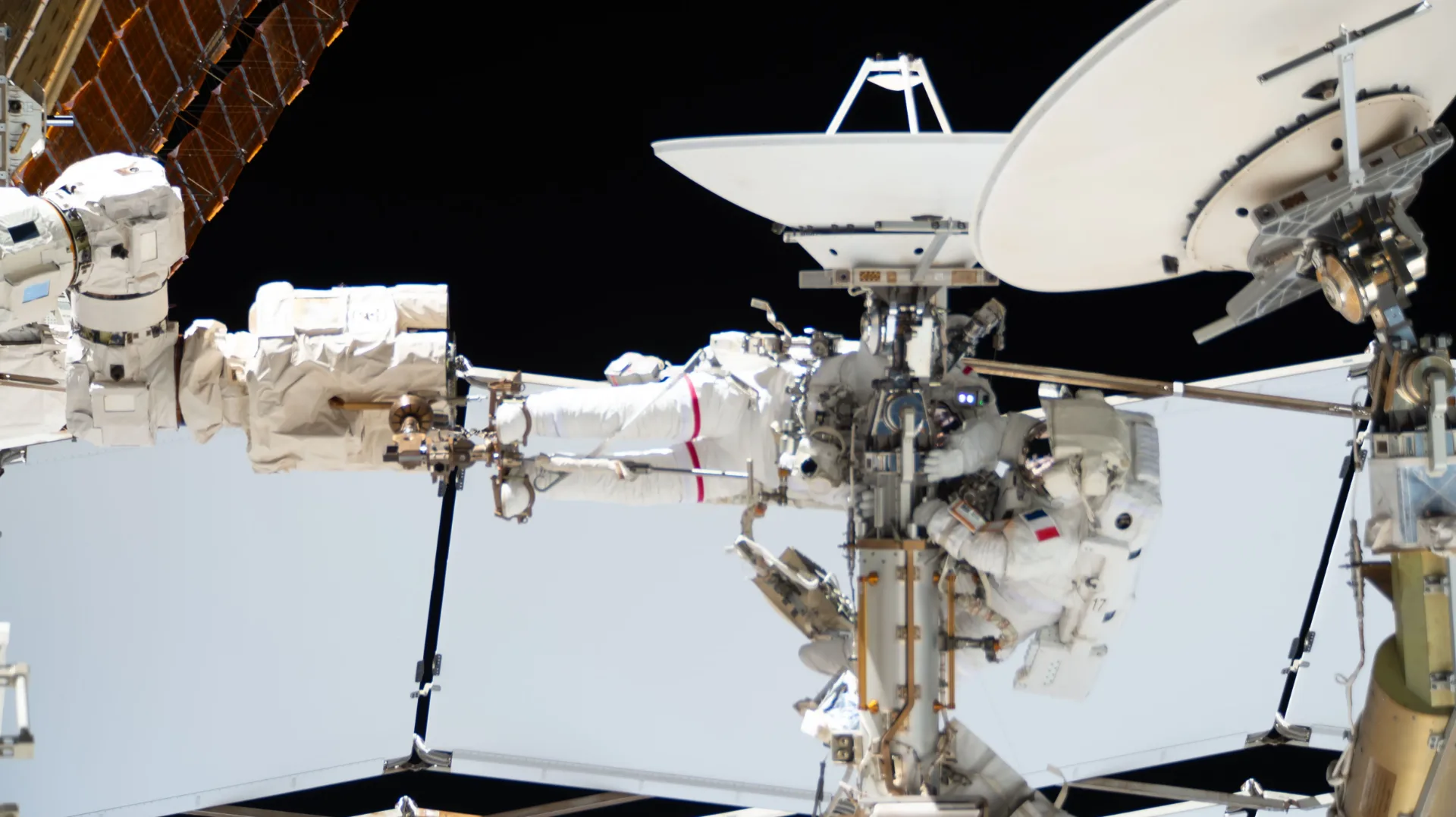
To look upon the International Space Station is to witness a fragile monument to human ambition suspended over an indigo void. On August 18, 2026, that monument served as the backdrop for a silent, high-stakes choreography of survival and technological evolution. For six hours and twenty-three minutes, Expedition 75 flight engineers Anil Menon of NASA—distinguishable by the crimson band slicing down his pressurized leg—and his European Space Agency counterpart, Sophie Adenot, floated in the soundless vacuum of low Earth orbit. Their mandate was both delicate and demanding: to finalize the installation of a next-generation high-speed communication transceiver, effectively rewiring the nervous system of humanity’s primary orbital outpost.
The work of an extravehicular activity (EVA) is frequently romanticized as a serene glide, but in truth, it is an exhausting, bruising exercise in micro-gravity mechanics. Every turn of a titanium bolt and every delicate connection of a data tether requires an intense calculus of physics, geometry, and raw muscle memory. Clad in bulky, pressurized suits that resist every movement of the fingers, Menon and Adenot moved with a deliberate, synchronized grace. Suspended some 250 miles above the turning curve of the Earth, the pair operated in 90-minute cycles of blinding solar glare and freezing orbital shadow, translating complex engineering schematics into physical reality with a quiet precision that belied the extreme environment around them.
> "To work in the vacuum is to exist in a state of hyper-focused solitude, where your partner’s voice in your helmet is the only anchor to humanity."
There is a striking irony in spending nearly six and a half hours in the deepest quiet of the cosmos simply to facilitate faster communication. Yet, this paradox is the very hallmark of our contemporary epoch. The partnership between Menon, an aerospace physician accustomed to high-stress triage, and Adenot, a trailblazing French helicopter test pilot, mirrors the broader synthesis of international scientific endeavors. As they secured the final conduits of the high-speed array, their gloved hands moving in silent concert against the white thermal blankets of the station, they did more than simply upgrade a piece of machinery; they reinforced the fragile, cooperative network that keeps our species tethered to the infinite.