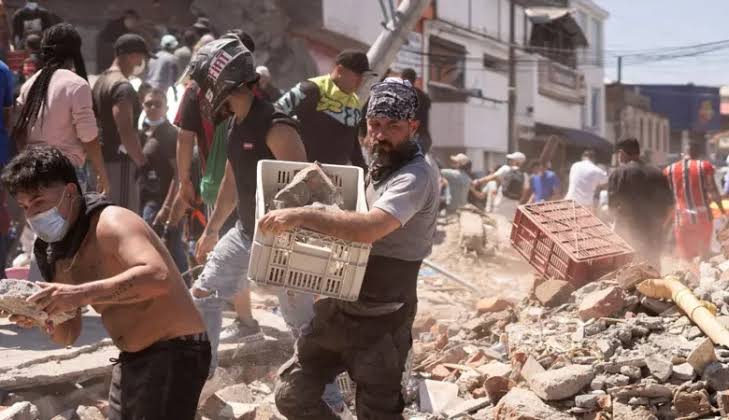
The Earth Divided: A Devastating Rupture on Colombia’s Pacific Coast
The ground beneath Chocó has always been defined by its restless, rain-slicked beauty—a place where the dense green canopy of Colombia’s Pacific coast meets an unforgiving ocean. But when a massive magnitude 7.4 earthquake struck the region, that wet, emerald landscape became the epicenter of a sudden and violent renegotiation of the earth. The rupture, the country’s most powerful in years, did not merely shake the ground; it tore through the fragile infrastructure of one of Colombia's most marginalized provinces, leaving at least 132 dead and a trail of ruin that stretches from coastal hamlets to the Andean interior.
Though the tectonic violence was birthed in the muddy depths of Chocó, its shockwaves behaved like a physical fever, radiating outward across hundreds of kilometers. In the high-altitude metropolitan centers of Medellín and Bogotá, office towers swayed like pendulums and residents poured into the streets in a collective panic, gripped by a passing vertigo. Yet, while the capital’s elite suffered only frayed nerves, the true tragedy was borne by the periphery. In Chocó, where municipal budgets are thin and concrete is often mixed with more hope than rebar, entire neighborhoods collapsed under their own weight. Landslides, triggered by the violent shaking of saturated mountainsides, swallowed roads and choked off the vital river arteries that serve as the region’s only highways.
```
"In Chocó, the line between daily survival and sudden catastrophe has always been paper-thin. This disaster simply erased it."
```
There is a cruel, familiar irony in the geography of this disaster. Chocó is a region rich in biodiversity and Afro-Colombian cultural heritage, yet it has long been neglected by the central state, languishing under the twin shadows of poverty and systemic isolation. The crumbling of homes in towns like Quibdó and Istmina is not just a failure of soil mechanics, but a stark indictment of a structural deficit. When the earth convulses, it inevitably exposes the unequal architecture of safety; those who live on the margins of the economy are almost always those who live closest to the fault lines of catastrophe.
As rescue workers, hampered by washed-out roads and torrential equatorial rains, claw through the rubble of remote settlements, Colombia enters a familiar period of national mourning. The immediate challenge is one of grim logistics—finding the missing, treating the injured, and restoring power to isolated communities. But beyond the immediate triage lies a quieter, more daunting reckoning for a nation striving for modern solidarity: a reminder that beneath Colombia's vibrant aspirations lies a physical and social landscape that remains profoundly, precariously unsettled.