The Crimson Mirror: How Wildfire Smoke Rewrote the Sky
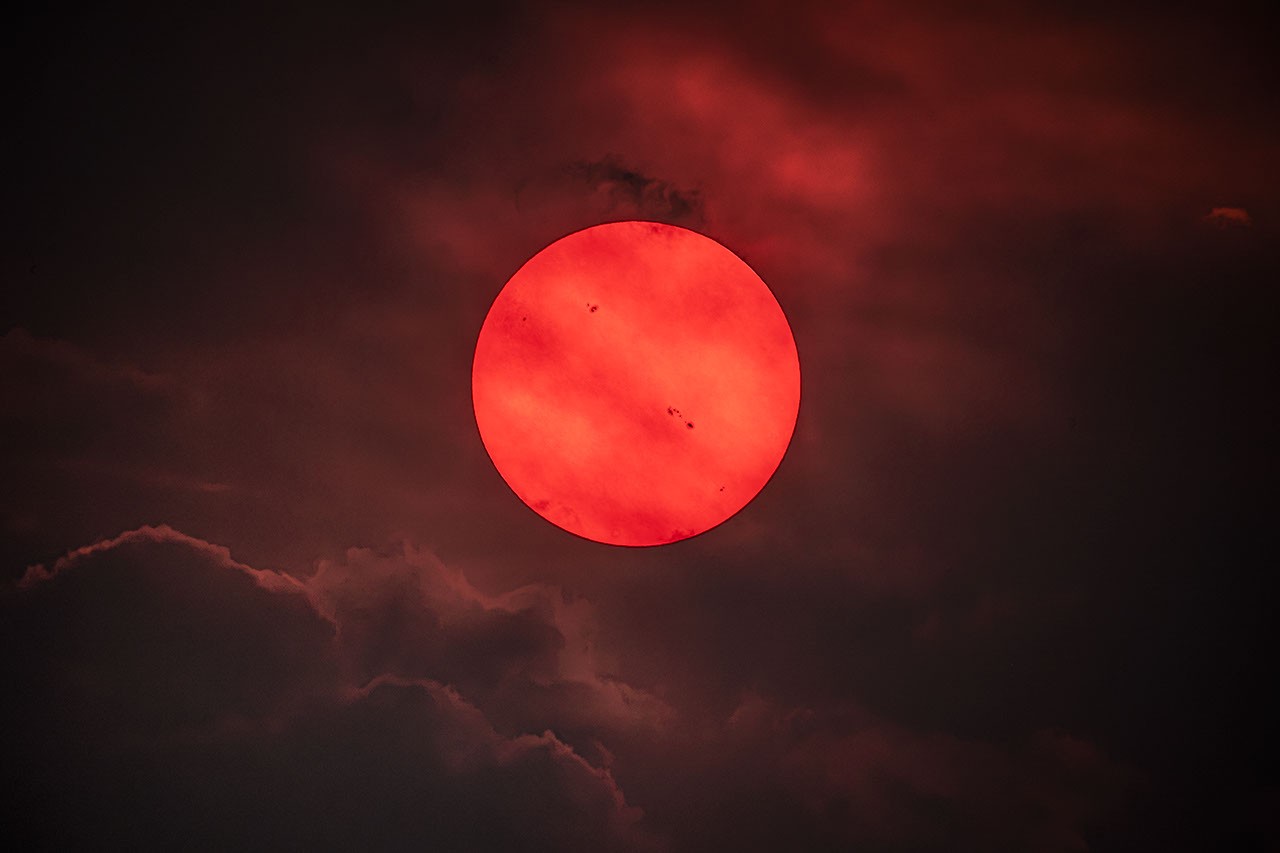
For over a quarter of a century, NASA’s Astronomy Picture of the Day (APOD) has functioned as a digital sanctuary of celestial escapism—a daily curatorial window offering glimpses of glittering star nurseries, serene Martian dunes, and the cold, elegant spirals of distant galaxies. Yet, on July 30, the cosmos looked back at us through a bruised and deeply terrestrial lens. The featured image, depicting a blood-red sun suspended in an ash-choked sky, was not a dispatch from some hostile, alien exoplanet, but a portrait of our own atmosphere filtered through the particulate haze of raging wildfires. It is a striking, melancholic image that transforms our local star from a source of warmth into a glowing emblem of planetary distress.
The physics governing this apocalyptic transformation are as precise as they are tragic. Under normal conditions, the Earth’s atmosphere scatters shorter wavelengths of light—the blues and purples—leaving the sun to appear a familiar, brilliant yellow. However, when massive wildfire plumes inject vast quantities of fine particulate matter into the troposphere, the scale of atmospheric scattering shifts. These microscopic carbon and ash particles act as a selective filter, scattering away the cooler spectrum of light while allowing only the longest, most stubborn crimson wavelengths to penetrate the gloom. The result is a sun stripped of its blinding glare, rendered as a defined, crimson orb that hangs in the daytime sky like a low-voltage bulb in a darkened room.
```
"The image serves as a stark reminder that the boundary between astronomy and ecology is increasingly porous."
```
There is a profound, almost gothic irony in this image being cataloged alongside the great wonders of the universe. For generations, humanity looked to the night sky to escape the mundanity of earthly troubles; now, our planetary crises are so vast they have begun to alter the very light of the heavens. This "Red Sun" phenomenon is no longer an anomalous curiosity, but rather the signature aesthetic of the Anthropocene—a recurring visual reminder of a warming globe. By capturing this sublime yet terrifying spectacle, APOD shifts its focus from the mysteries of deep space to the immediate, fragile reality of our own atmosphere, reminding us that the most urgent celestial body we need to study is the one we currently inhabit.