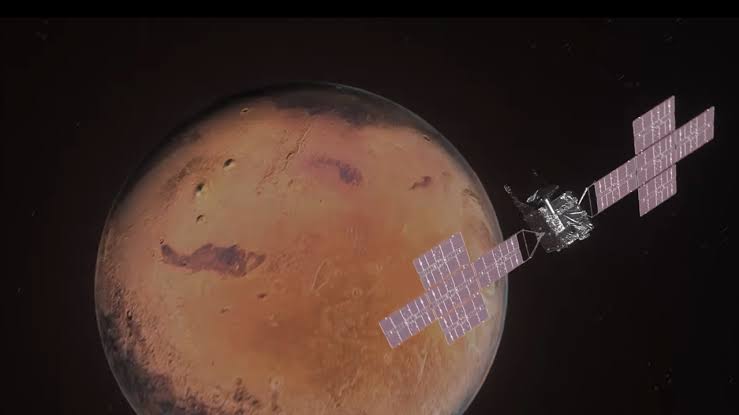
The Red Slingshot: Psyche’s Silent Dance with Mars in the Deep Dark
In the vast, vacuum-sealed theater of the solar system, movement is rarely a straight line; it is a complex, mathematical waltz of attraction and momentum. This July, NASA’s Psyche spacecraft executed its most critical choreography yet, sweeping past the rust-hued expanse of Mars in a precision gravity assist. Captured in a mesmerizing sequence released by the space agency, the flyby was less a conventional journey and more an act of elegant celestial theft. By skimming the outer limits of the Martian gravitational well, the metallic explorer siphoned a fraction of the Red Planet’s orbital energy, catapulting itself with renewed velocity toward the dark frontier of the outer asteroid belt. It is a stark reminder that in the architecture of deep space, gravity is not merely a force to be resisted, but a currency to be spent.
Launched in late 2023, Psyche is a mission born of a profound, almost archaeological curiosity about our own planetary origins. Its ultimate destination is 16 Psyche, a bizarre, metal-rich asteroid hypothesized to be the exposed nickel-iron core of an ancient, shattered protoplanet—the naked heart of a world that never was. To reach this metallic relic, however, requires a journey of some 2.2 billion miles, a distance far too vast for conventional propulsion to conquer alone. Enter Mars. The gravity assist serves as a vital cosmic slingshot, saving years of travel time and preserving precious propellant. In the hauntingly beautiful footage of the encounter, the probe appears as a delicate, solar-winged sentinel gliding past the imposing, cratered face of Mars, a striking contrast of fragile human engineering set against the indifferent, ancient scale of the cosmos.
There is a quiet, almost poetic insolence in how humanity navigates the void. We launch gossamer structures of titanium and silicon into the dark, relying on the invisible, curving fabric of spacetime to guide them home. The imagery of Psyche’s Martian rendezvous captures this duality perfectly. It showcases not just a triumph of orbital mechanics, but a profound narrative milestone: the translation of raw physics into a sublime visual record. As the spacecraft recedes from Mars, bound for its dark, metallic quarry, it carries with it the quiet confidence of an species that has learned to use the weight of giant worlds to fling its dreams into the unknown.