The Celestial Interloper: Comet Tempel 2’s Choreographed Deception
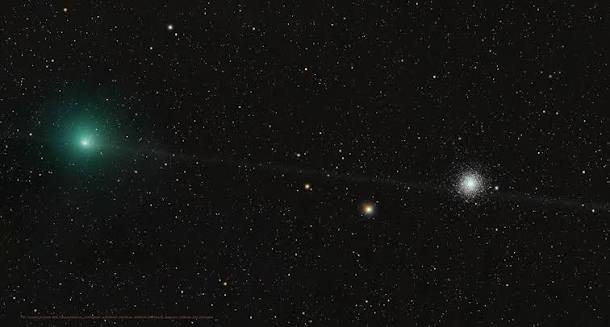
There is a historical irony baked into the very fabric of observational astronomy: we navigate the infinite through a catalog of disappointments. In the late eighteenth century, the French astronomer Charles Messier, single-mindedly obsessed with hunting comets, painstakingly mapped 110 fuzzy, static celestial objects solely so he and his contemporaries could ignore them. Today, those "nuisances"—the glittering nebulae, ancient star clusters, and distant galaxies of the Messier catalog—are the crown jewels of the night sky. NASA’s Astronomy Picture of the Day captured a sublime reversal of this historical comedy. In a mesmerizing time-lapse video, Comet 10P/Tempel 2, a nomadic ball of primitive ice and soot, was filmed drifting through these very monuments of permanence, staging what astronomers have affectionately termed a "Messier Moment."
```
"The universe is not a static museum, but a theater of perpetual transit, where even the most meticulous ledgers of science are destined to be disrupted by fleeting interlopers."
```
The video featured by NASA is a masterclass in cosmic chiaroscuro. Unlike the blazing, tail-heavy apparitions of popular imagination, Tempel 2 is a more subtle, brooding wanderer. With an orbit of just over five years, it is a frequent visitor to our cosmic neighborhood, yet its low-albedo nucleus—rich in carbonaceous dust—reflects less light than a freshly asphalted highway. In the featured footage, however, the comet sheds its habitual obscurity. As solar radiation coaxes a ghostly, glowing green coma of cyanogen and diatomic carbon from its icy crust, Tempel 2 is transformed. The time-lapse captures this ethereal traveler gliding across a crowded stellar backdrop, a kinetic smudge of emerald light threading the needle through the frozen, unchanging geometry of deep space.
To watch Tempel 2 trace its path is to confront the dual nature of our relationship with the cosmos: our obsession with tidy taxonomy versus the universe’s obstinate refusal to stay still. Messier sought to clean up the sky, to partition the permanent from the passing. Yet, as this modern digital rendering reveals, the true poetry of the night sky lies precisely in their collision. The comet, a pristine leftover from the solar system’s birth some 4.6 billion years ago, acts as a dynamic paintbrush, temporarily illuminating the cold canvas of the cataloged heavens. It serves as a visual reminder that our maps of the cosmos are merely temporary brackets around a reality defined by perpetual motion.