The Rain of Perseus: When the Darkened Sky Held Its Breath
Every August, humanity engages in a collective, neck-straining ritual. We look up, seeking a brief escape from our frantic terrestrial anxieties in the burning debris of Comet Swift-Tuttle. In 2026, however, this annual pilgrimage yielded something transcendent. The cosmos offered a rare, uncompromised theater, largely because the Moon—usually a brilliant saboteur of starlight—willingly retreated into a cooperative, dark phase. Left with an obsidian canvas, stargazers were treated to a celestial display of rare clarity. This was the year the Perseid meteor shower did not merely whisper across the vault of heaven; it wrote its incandescent signature with bold, unforgettable strokes.
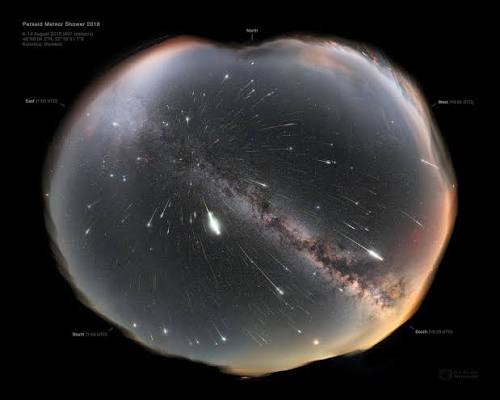
To witness the Perseids is to watch a slow-motion collision between deep-time cosmic relics and our fragile atmosphere. What the human eye perceives as a romantic streak of light is, in truth, a violent, beautiful vaporization. Particles of dust and ancient ice, shed by the comet over millennia, collide with Earth's thermosphere at a staggering sixty kilometers per second. Photographers who pointed their lenses toward the northern sky captured a striking geometry. The meteors appeared to streak outward like silver spokes from a cosmic wheel, their trajectories tracing backward to a singular origin point: the heroic constellation of Perseus. This radiant point provides a masterclass in celestial perspective, a visual proof that our planet is actively carving its path through a crowded, kinetic universe.
> "In the silent flash of a meteor, we find a rare moment of collective stillness—a reminder that we are passengers on a damp rock hurtling through a brilliant, indifferent void."
In an era defined by the relentless glow of artificial screens and the claustrophobia of modern life, there is a quiet, radical politics to standing in a dark field waiting for a rock to burn. The 2026 Perseids reminded us of the elegance of patience. As curated by NASA's daily cosmic archives, the imagery of this year’s shower serves as more than a scientific record; it acts as a secular liturgy. It demands that we look outward, offering a fleeting antidote to our self-absorption and reminding us that the most spectacular shows on Earth require us to first extinguish our own light.