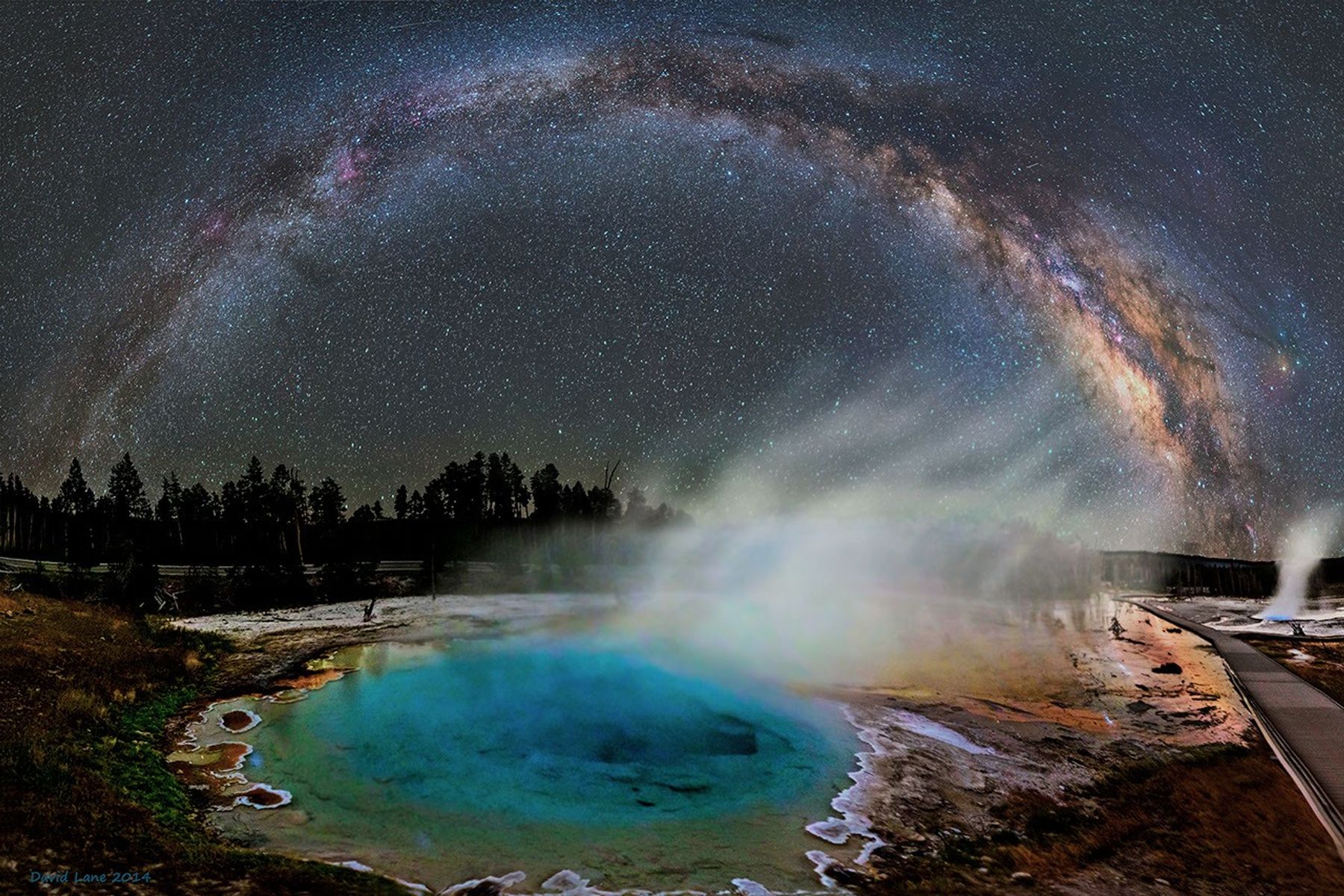
The Chthonic and the Cosmic: Yellowstone’s Primal Nights Meet the Galactic Stream
On the night of August 16, 2026, NASA’s Astronomy Picture of the Day offered a startling, almost sacred juxtaposition: the terrestrial volatility of Yellowstone National Park framed against the silent, eternal drift of the Milky Way. In this captured sequence—not merely a static frame but a mesmerizing time-lapse video—the earth’s raw, hydrothermal belly breathes sulfurous steam into an atmosphere illuminated by the ancient light of a hundred billion stars. It is an image that demands its viewers look both downward into the primordial fires of our planet's creation and upward into the infinite dark of our cosmic future. The stark silhouette of lodgepole pines and the ghostly, backlit plumes of geothermal vents serve as a dark, terrestrial stage, acting as anchor-points for a galactic river that seems to flow directly from the steam of the geysers themselves.
The genius of this curation lies in its profound temporal tension. Captured by a patient, long-exposure lens, the video medium transforms the celestial dome from a static backdrop into a dynamic engine. We watch the Earth rotate beneath the galactic core—a slow, majestic carousel that renders our frantic, modern anxieties beautifully insignificant. In an era where digital content is characterized by a relentless, attention-seeking hyper-velocity, this visual document functions as a masterclass in slow cinema. The geysers pulse with a rhythmic, subterranean urgency, while overhead, the dust lanes and stellar nurseries of the Sagittarius arm wheel in silent, indifferent synchronization. It is a reminder that Yellowstone is not merely a wilderness preserve, but a thin, fragile crust suspended over a molten abyss, looking out into an even greater void.
Ultimately, this collision of the chthonic and the cosmic serves as a secular liturgy for the modern viewer. Since its inception, NASA’s Astronomy Picture of the Day has acted as a quiet, daily correction to humanity’s anthropocentric hubris. By pairing the volatile, volcanic heart of North America with the cold elegance of the Milky Way, the feature transcends simple astronomical documentation to become a profound piece of visual poetry. It forces a reckoning with scale: here we stand, perched on an active supervolcano, hurtling through a suburban spiral arm of a commonplace galaxy, watching a celestial performance that requires no audience to justify its grandeur. It is a sublime reminder that we are not merely passive observers of the cosmos, but the very dust of Yellowstone’s geysers and the Milky Way’s stars, momentarily wakeful, looking back at ourselves.