The Quiet Architecture of Exploration: Inside the Chamber Where NASA Calibrates the Future of Deep-Space Radar
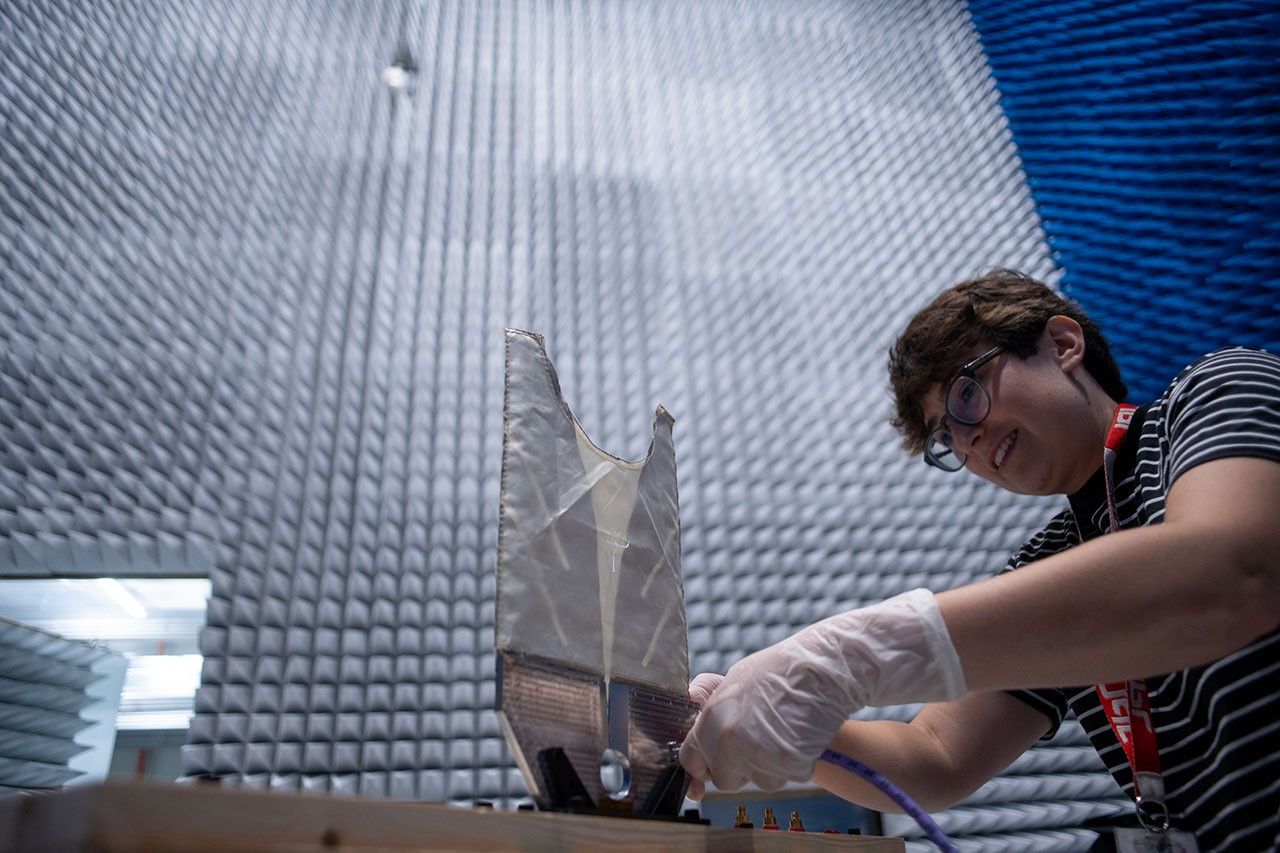
In the hushed, geometric sanctuary of the Environmental Test Lab at NASA’s Jet Propulsion Laboratory in Southern California, the future of planetary exploration is currently being calibrated in decibels of absolute silence. Shielded from the relentless electromagnetic smog of the modern world, ground-penetrating radar engineer Maya Román performs a delicate, near-choreographic sequence of connectivity. Leaning over a specialized test antenna destined for NASA’s upcoming SkyFall mission, Román secures a coaxial cable with the quiet, practiced precision of a microsurgeon. The electromagnetic interference (EMI) testing chamber around her—insulated with dark, pyramidal foam designed to swallow stray radio waves—feels less like a conventional laboratory and more like an echoic cathedral dedicated to the preservation of signal purity. It is within this vacuum of noise that humanity prepares to peer beneath the frozen crusts and dusty regoliths of distant worlds.
The SkyFall mission represents an audacious leap forward in planetary reconnaissance, utilizing a sophisticated payload of four integrated scientific instruments to map subterranean landscapes that have remained hidden for eons. At the core of this scientific suite is its ground-penetrating radar, an instrument whose success hinges entirely on the flawless performance of its antenna pattern. During these critical diagnostic trials, the antenna is deliberately oriented upward toward the ceiling—an elegant, counterintuitive posture meant to minimize ground reflections and prevent terrestrial feedback from distorting the measurements. This skyward gaze is both a technical necessity and a striking metaphor: a machine designed to dissect the deep interiors of alien bodies must first prove its fidelity by staring blankly into the artificial void of its Southern California testing cell.
```
"A machine designed to dissect the deep interiors of alien bodies must first prove its fidelity by staring blankly into the artificial void of its testing cell."
```
There is a profound, almost literary irony in the scale of these preparations. Long before a spacecraft can survive the violent kinetics of a rocket launch or the frigid, radiation-drenched isolation of deep space, it must first survive the grueling, invisible gauntlet of Earth-bound simulation. Román’s meticulous adjustments in the EMI chamber underscore the fragile micro-negotiations that govern modern aerospace engineering—where the success of a multi-million-dollar voyage across the cosmos ultimately depends on the integrity of a single coaxial connection and the eradication of a decibel of stray interference. As the SkyFall mission edges closer to its eventual launch, these quiet, subterranean rehearsals in Pasadena serve as a stark reminder that our grandest leaps into the cosmic unknown are anchored by the quietest, most disciplined moments of human focus.