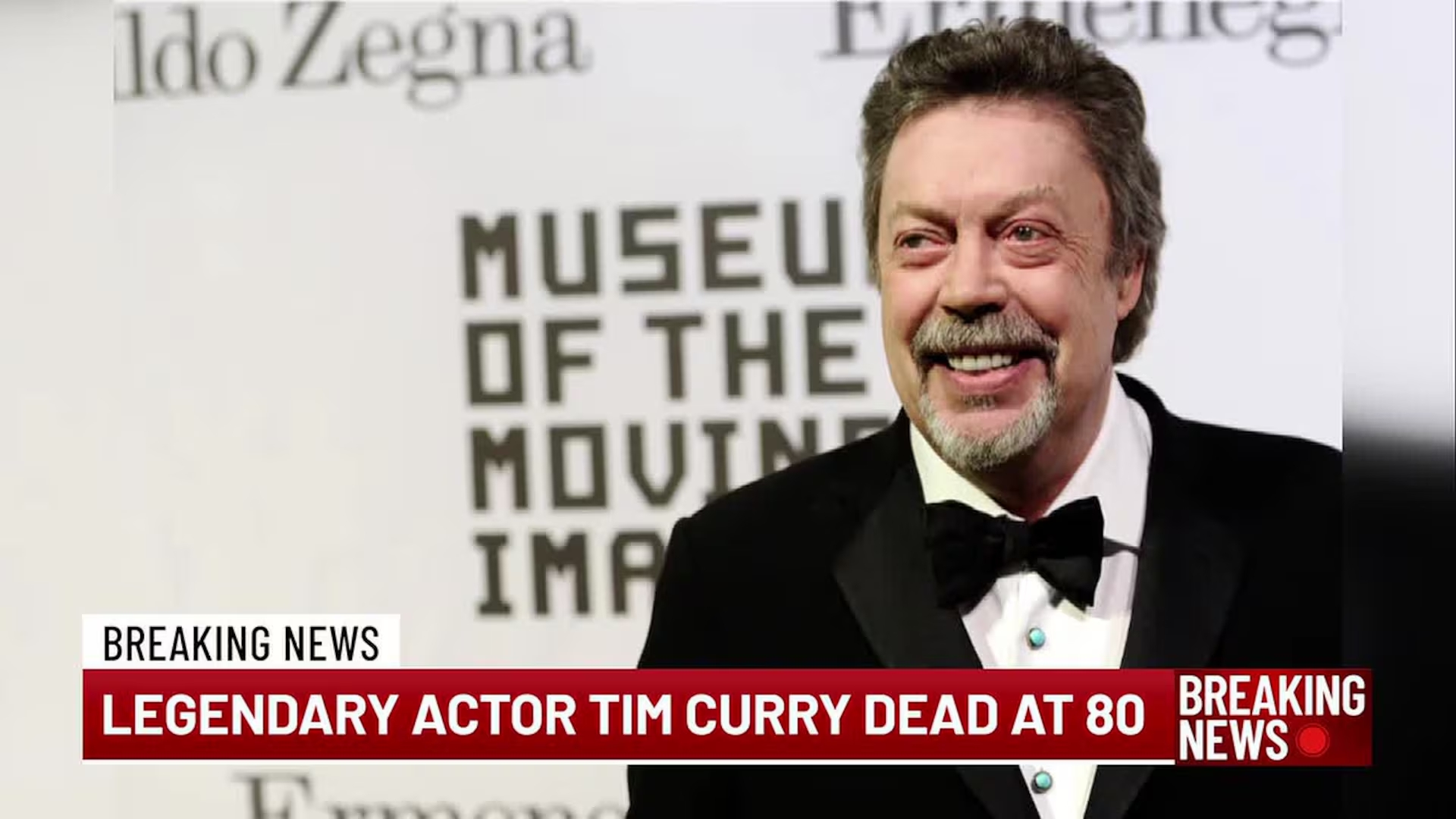
The Sovereign of Delicious Malice: Tim Curry Dies at 80
There was always something deliciously dangerous about Tim Curry’s charisma, a performance style that did not merely invite the audience's gaze but demanded its surrender. The legendary British actor, whose career traced a glittering, subversive arc across stage, screen, and the cultural subconscious, has died at the age of 80. While his later years were quieted by the sobering aftermath of a major stroke in 2012, his legacy remains loud, lavish, and wonderfully defiant. To look back on Curry is to confront an artist who understood, perhaps better than any of his contemporaries, that the line between terror and ecstasy is razor-thin, and that the most memorable monsters are always the ones having the most exquisite fun.
He will, of course, forever be consecrated in the temple of midnight cinema as Dr. Frank-N-Furter, the corset-clad, sweet-talking mad scientist of The Rocky Horror Picture Show (1975). In an era still wrestling with the rigid binaries of mid-century masculinity, Curry’s entrance—strutting in patent-leather platforms, draped in pearls, and dripping with pansexual swagger—was nothing short of a cultural detonation. He did not play the role with the defensive wink of camp; instead, he inhabited it with a lethal, aristocratic conviction. He weaponized desire, turning a low-budget tribute to B-movies into a secular liturgy for misfits, rebels, and the sexually disenfranchised. To generations of seekers, he was not merely an actor in a cult film; he was the high priest of self-invention.
```
"Don't dream it, be it."
— Tim Curry as Dr. Frank-N-Furter
```
Yet to confine Curry to the shadow of the transvestite's laboratory is to ignore the astonishing breadth of a chameleon who wore villainy like a bespoke suit. Whether terrorizing a generation of children as the definitive, grease-painted Pennywise in the 1990 miniseries adaptation of Stephen King’s It, or embodying the literal, crimson-skinned personification of Darkness in Ridley Scott’s Legend (1985), Curry possessed a singular theatrical alchemy. His voice—a rich, purring baritone that could slide effortlessly from a velvet caress to a serrated sneer—became his ultimate instrument. He was the hyperactive butler Wadsworth in Clue (1985), delivering a masterclass in physical comedy and linguistic velocity, just as easily as he was a Shakespearean classical actor or a Tony-nominated Broadway force. He understood that the grotesque and the sublime were twin siblings, and he played both with a symphonic gusto.
In our contemporary cultural landscape, which is so often dominated by sanitized, focus-grouped celebrity and predictable aesthetic caution, Curry’s departure feels like the extinguishing of a far more daring fire. He was an actor of exquisite excess, a performer who never sought the safe harbor of the ordinary. Even as health struggles limited his physical mobility in his final decade, his artistic spirit remained undiminished, as he continued to lend his voice to animation and make rare, cherished appearances with a conspiratorial sparkle in his eye. He leaves behind a world that is slightly more beige, slightly less thrillingly strange, but forever transformed by the beautiful, lawless mark he left upon it.